

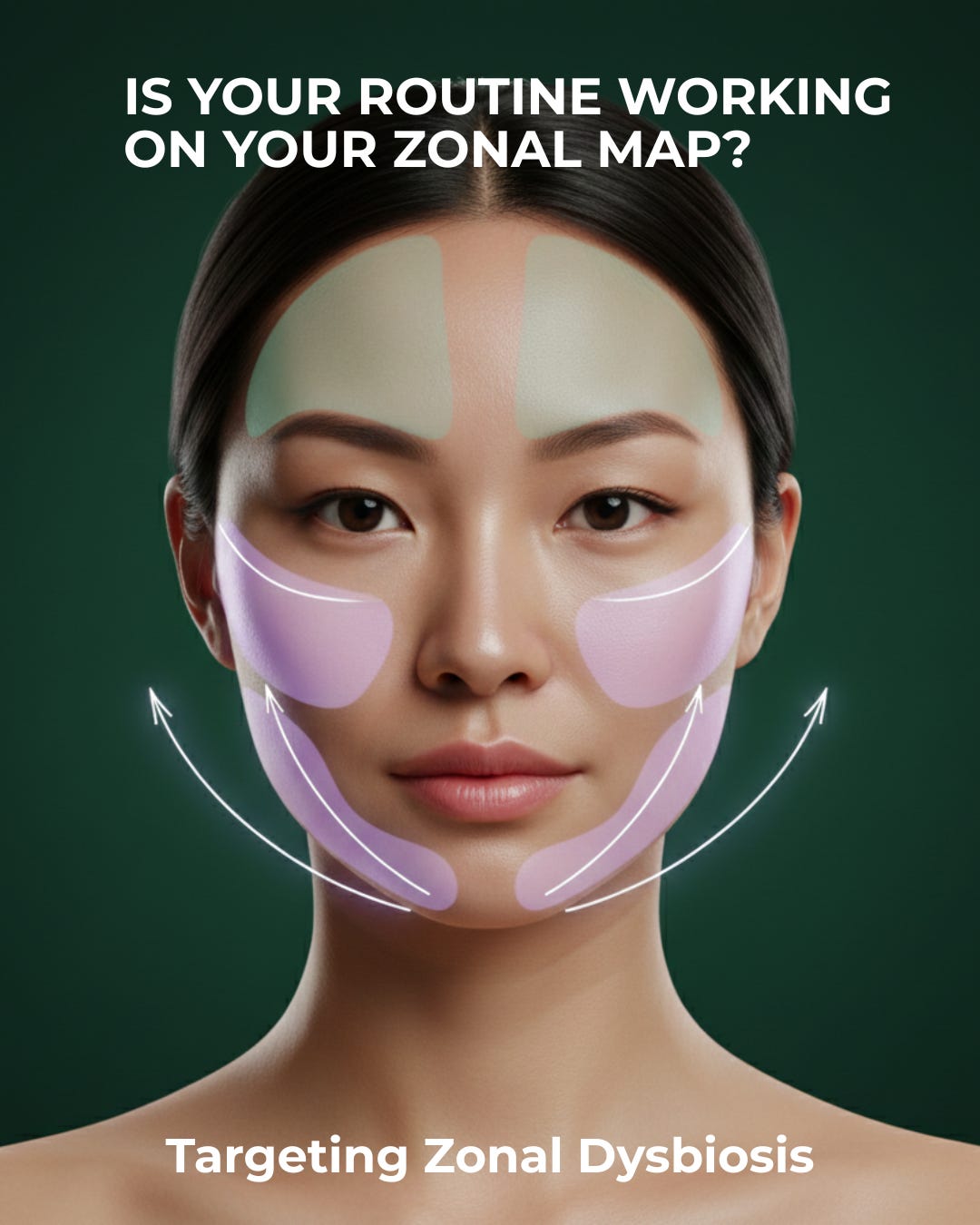
Skin doesn’t come in three boxes anymore—dry, oily, sensitive. It behaves like an ecosystem, and different zones on the same face can live in completely different climates. In this post, I’ll walk you through how we decode this zonal dysbiosis concept in Asian skin, and how it shapes evidence-based routines rather than trial‑and‑error skincare.
From Skin Type to Skin Ecosystems
Traditional skin typing assumes your whole face behaves the same way, all the time. What we see clinically and in the lab is the opposite: your T‑zone, cheeks, and lower face can each respond differently to hormones, humidity, and pollution.
Zonal dysbiosis: local imbalances in the skin microbiome where one area is oily and acne‑prone while another is dry or sensitive.
Asian skin often shows higher transepidermal water loss (TEWL) and a more reactive pigmentary system, so these local imbalances translate quickly into redness, breakouts, and post‑inflammatory hyperpigmentation.
At the Dr. TWL Asian Skin Research Institute, we treat the face as multiple ecosystems, not a single type, and build protocols around those micro‑environments.
The O‑Zone: Where Problems Converge
I first coined the term O‑Zone in a 2021 JAAD white paper to describe the topographical area over the malar and mandibular arches—the lower face forming an O‑shape around the mouth and jawline. This is often where patients feel “everything happens at once.
The O‑Zone is a clinical hotspot for:
Hormonal acne – due to androgen sensitivity in the lower third of the face.
Rosacea – where vascular hyper‑reactivity coexists with a fragile barrier.
Perioral dermatitis – a microclimate‑sensitive condition, often flared by irritant topicals and humidity.
Importantly, this zone has been further studied in the context of maskne microbiome changes, where occlusion and humidity intensify dysbiosis.
Ethnobotanical Harmonisation: Balancing Sebum at the Source
Instead of simply drying out oily skin, the lab focuses on enzyme‑level control of sebum. A key player here is 5‑alpha reductase, the enzyme that converts testosterone to dihydrotestosterone (DHT), which drives sebaceous gland activity.
Lipidosterolic extracts such as Saw Palmetto (Serenoa repens), Argan, and Sesame are used to inhibit type I and II 5‑alpha reductase via non‑competitive (allosteric) mechanisms.
Clinically, this reduces DHT‑driven sebum production in the T‑zone and O‑Zone, helping acne‑prone areas without stripping drier regions.
The approach is grounded in peer‑reviewed data on saw palmetto extracts and their 5‑alpha‑reductase inhibitory potency.
From a practical standpoint, this means we can design zonal formulations that subtly rebalance oil, rather than blanket‑mattifying the entire face.